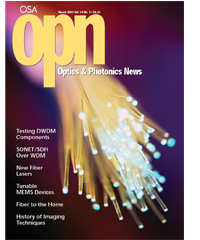
March 2003 Issue
Feature Articles
Fiber to the Home Why "the Last Mile" Is Truly the Hardest
After decades of talk, fiber-to-the-home installations are now a reality in some U.S. communities. The key players are not giant phone or cable-TV companies but small public utilities, rural phone cooperatives and upscale housing developers.
by Jeff HechtThe Evolution of SONET/SDH Over WDM
Among the promising innovations moving to market: a fully automated optical layer and fully integrated synchronous optical network/synchronous digital hierarchy over wavelength division multiplexing.
by Paul BonenfantNovel Fiber Lasers and Applications
Under impetus from the telecom market, new types of fiber lasers have been developed and deployed. On the horizon are new applications that demand transmission at different wavelengths and higher output powers.
by Luis A. Zenteno and Donnell T. WaltonTunable MEMS Devices for Optical Networks
Dynamic wavelength provisioning is the greatest benefit associated with the use of tunable lasers and filters in transparent networks. A prerequisite is the availability of tunable devices that meet the rigorous performance requirements of fixed wavelength transceivers—at comparable costs.
by Jill D. Berger and Doug AnthonThe Invention of "Light Writing," or How the Cosmos Came to Draw Itself
In the nineteenth century, scientists began to explore ways of “fixing” the image thrown by a lens. The invention of the daguerreotype was followed by the appearance of less expensive techniques, including the tintype. The photoheliograph, a device for taking telescopic photographs of the sun, was unveiled in 1854.
by Brian S. BaigrieDepartments and Columns
A Software Package for Scientific Presentations Using LaTeX
Prospect is a macro package that can produce PowerPoint-like slides with a LaTeX interface. This article explains how to obtain and install the software.
OSA Fellow Travel Grant Opens Doors in Russia
To increase awareness of optics and photonics around the world, each year OSA awards a grant of up to $1000 to fund travel by Fellows to developing nations. Barry R. Masters, one of the 2002 recipients of the Fellow Travel Grants, travelled to Russia in October, where he lectured on nonlinear optical microscopy, confocal microscopy and in vivo three-dimensional (3D) imaging of the human cornea and lens.
Fun With Photonics: Experiments with Optically Active Materials
OSA Fellow Keigo Iizuka developed the hands-on learning program, “Fun with Photonics,” to spark interest in optics among members of the general public. The series was first presented to automotive engineers at Omron Corporation, Komaki City, Japan. In this, the fifth installment in the series, Iizuka describes the fundamental characteristics of optically active materials.
Interaction of Light with Subwavelength Structures
When a light field interacts with structures that have complex geometric features comparable in size to the wavelength of the light, it is not permissible to invoke the assumptions of the classical diffraction theory, which simplify the problem and allow for approximate solutions. For such cases, direct numerical solutions of the governing equations are sought through approximating the continuous time and space derivatives by the appropriate difference operators.
The Launch of OSA’s Second Journal: Applied Optics
The OSA Board of Directors, meeting in New York City in 1959, decides the time has come for a second journal. The decision is motivated in part by a desire to meet the competition of commercial publications, chief among them Infrared Physics.
Scientist Lobbying Led to Newest NIH Institute
The newest addition to the National Institutes of Health—the National Institute of Biomedical Imaging and Bioengineering—is the fruit of persistent lobbying by scientists and engineers. The institute, which hosted its first advisory council meeting in January, took an important step forward when radiologist Roderic Pettigrew became its first director last fall.
Recommendations of the OSA Publications Long-Term Planning Group
A recently published report on what’s in store for OSA publications says that print-journal subscriptions may dwindle and subscriptions to online journals will thrive through the end of the decade. The report also predicts that OSA can continue to rely on this primary source of net revenue.
Being in the Right Place at the Right Time
This month’s “Optical Entrepreneur” is the second column in a two-part series about positioning a company to target a profitable market.

![A multiplexed image of a human tonsil acquired. [NIAID] using the iterative bleaching extends multiplexity (IBEX) method.](https://opnmedia.blob.core.windows.net/$web/opn/media/images/articles/2024/0424/departments/202404-cover-web.jpg?ext=.jpg)