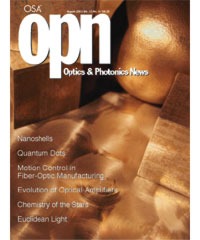
August 2002 Issue
Feature Articles
Cavity-QED Using Quantum Dots
Semiconductor quantum dots, also referred to as artificial atoms, provide a new paradigm for studying quantum optical phenomena. The effects of cavity-quantum electrodynamics (QED) can be investigated by use of a single quantum dot embedded in a photonic nanostructure. Since quantum dot location inside the cavity is fixed by growth, this system is free of the stringent trapping requirements that limit its atomic counterpart. Fabricating photonic nanostructures with ultrasmall cavity-mode volumes enhances the prospects for applications in quantum information processing.
by Atac ImamogluThe Optical Properties of Nanoshells
Metal nanoshells are a new addition to a growing “toolbox” of subwavelength optical components, such as quantum dots, other metal nanostructures such as nanorods or nanospheres, colloid-based photonic crystals, and polymer nanostructures. The author describes the use of nanoshells to inhibit photo-oxidation in conducting polymers, and the development of a nanoshell-hydrogel composite with a dramatic optomechanical response with applications in laser-controlled drug delivery.
by Naomi HalasThe Role of Precision Motion in Fiber-Optic Manufacturing
In the manufacture of fiber-optic components, the use of semiautomatic and even manual processes has led to exceptionally high failure rates. This limits the application base and makes it virtually impossible to support high-volume production. The author explores the challenges of effective motion control on the modern component-alignment platform.
by Alan FeinsteinThe Evolution of Optical Amplifiers
Today, erbium fiber amplifiers carry signals thousands of kilometers in submarine cables and transmit dozens of channels at 10 Gbit/s in commercial land systems.
by Jeff HechtEuclidean Light: High-School Geometry to Solve Problems In Gaussian Beam Optics
It is possible to describe the propagation of a gaussian beam using diagrams based only on Euclidean geometry. All that is needed to solve problems is a ruler and a pair of compasses.
by Michael Spurr and Malcolm DunnThe Chemistry of the Stars
The view that stars were solely objects of mathematical analysis that would forever lie beyond the realm of physics was dispelled by Gustav Robert Kirchhoff in 1860. Kirchhoff's science of spectroscopy revealed that distant stars are composed of the chemical elements found in earthly bodies. His revelations transformed the astronomer into something of a chemist, and the chemist into something of an astronomer.
by Brian S. BaigrieDepartments and Columns
University of Southampton Takes Science Into the Schools
As part of a plan to revolutionize the way local school children view physics, OSA’s University of Southampton (U.K.) Student Chapter has developed an optics roadshow.
Latin American Optics Pushes Forward
The middle of the 20th century saw the rapid development of the physics community in Latin America, fueled by strong government support, mainly in the area of atomic physics. In the current economic situation, however, all Latin American scientists—including optics researchers—must rely on a mixture of initiative, creativity, and versatility to keep the tradition alive.
Albert Abraham Michelson: Father of the Interferometer
In this issue, OPN begins a series of biographies that highlight the careers of outstanding personalities in the history of optical science. These men and women, many of them Nobel Prize winners, are towering figures in 20th century physics. The first article profiles Albert Abraham Michelson (1852-1931), the first American to win the Nobel Prize in physics.

![A multiplexed image of a human tonsil acquired. [NIAID] using the iterative bleaching extends multiplexity (IBEX) method.](https://opnmedia.blob.core.windows.net/$web/opn/media/images/articles/2024/0424/departments/202404-cover-web.jpg?ext=.jpg)