When people think of archaeology, they often conjure images of adventurers such as Indiana Jones, who spend most of their time searching for mysterious ancient objects. We forget that the main objective in archaeology is to uncover the history hidden behind the objects, in the hope that they can help us understand a small fraction of the immense puzzle that is the past. Artifacts typically make a long journey from archaeological site to museum show case—with many stops along the way at high-tech research facilities. In a discipline known as archaeometry, scientists use a number of chemical and physical procedures to obtain information from an archaeological artifact. Probably the most well-known strategy is the use of the radioactive isotope carbon-14 (14C) to date biological samples. For non-organic objects, more indirect techniques may be used to allocate them to a particular historical context, such as studying the geological substrate where the piece was found or even the artistic style of the piece. Whenever possible, however, scientists opt for more direct techniques that gather qualitative and quantitative information about the chemical composition of the object.
With this information, researchers can trace the evolution of certain fabrication technologies through history. This information not only helps them to date archaeological objects, it enables them to identify the fabrication place and sources of raw material, revealing details about ancient trade and provenance. Analysis of chemical compounds in archaeology has been routinely based on ion beam and X-ray techniques. Photonics enters the field of archaeometry mainly through the use of spectroscopic techniques, such as Raman spectroscopy, laser-induced fluorescence (LIF) and laser-induced breakdown spectroscopy (LIBS). These technologies allow for the fast, in situ identification of the chemical composition of a great variety of objects.
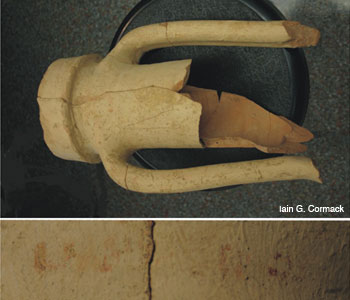
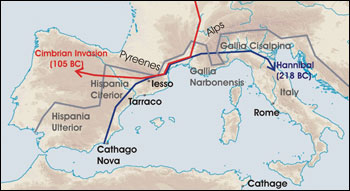
Our archaeological problemIn our case, we were looking for a way to uncover information painted on the surface of a wine amphora that could help determine the foundation date of the Roman village of Iesso, which is nowadays the city of Guissona in Catalonia in northeast Spain. Archaeologists from the Institute of Classical Archaeology of Catalonia (ICAC) found this amphora among others near the city walls.
|
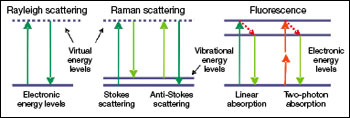
Because the names and time frames for all the Roman consuls are known, this finding would allow us to date the foundation of the Roman city of Iesso. Unfortunately, at the moment of the discovery, the paint used to write the consular date was barely readable. In addition, since its discovery, natural photobleaching had taken its toll, and the archaeologists’ initial method for reading the inscription (humidifying the painted area with a water solution) had remarkably further deteriorated the quality of the paint. Using this method, the archaeologists were able to identify only the next group of letters: Q • FAB • ……….. • COS The first letters are the initials for Quintus Fabius, the first consul, while the last three letters signify Consolibus, a Latin word meaning “being consuls.” The name of the second consul should have been located at the space between these two groups of letters (i.e., the dotted line). However, this area was considerably damaged and most of the paint had disappeared, making it impossible to decipher the second consul name. Unfortunately, the knowledge of the first consul is not enough, since, during the same period, two different consuls owned the same name. To uncover the missing name, we needed a detection technique that was able to detect and map small amounts of paint or some of its components (pigments or agglutinant). After examining the possible laser techniques, we discarded the use of LIBS and Raman spectroscopy. In the first case, the semi-destructive nature of LIBS could damage the sample. In the second, the Raman signal generated by such a small amount of paint would be hardly distinguishable from the background signal generated by the pottery. We decided that a technique based on fluorescence appeared to be the best option. Fluorescence from the paint is usually generated by the agglutinant, while the pigment, which is generally composed of metallic elements, inhibits it. This characteristic was quite convenient for our purposes; it helped us to identify previously painted areas where the pigment had disappeared but the agglutinant has persisted.
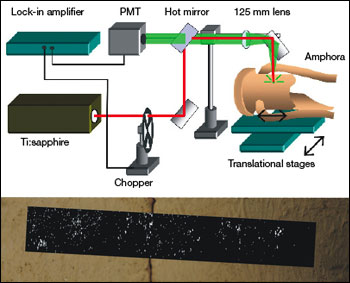
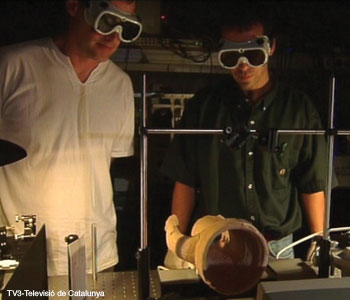
The amphora has been preserved in a dark area. Thus, an obvious requirement of our experiment was to avoid, at any price, laser-induced photodamage. This immediately prevented us from using high-energy photons for exciting the fluorescence. Unfortunately, it is known that the agglutinant used by the Romans (casein or albumin) fluoresces in the visible. This would require green-to-UV excitation sources, increasing the risk for photodamage. An alternative that was available in our lab was the use of femtosecond laser pulses to produce two-photon excitation fluorescence (TPEF), which allowed us to use near-infrared light as the excitation source, thereby greatly reducing the probability of producing photodamage. Two-photon fluorescence imagingThe best known use for the non-damaging properties of TPEF is in nonlinear microscopy for biological applications. Nonlinear microscopy uses infrared light to help ensure cell viability and is the technique of choice for imaging in vivo over extended observation periods. Our experimental set-up, shown in the figure below, reproduces a typical nonlinear microscope scheme, except for the fact that, for our purposes, high resolution was not required. In fact, the beam of a titanium:sapphire mode-locked laser was gently focused on the painted area on the amphora. The fluorescence signal was captured by a lens and directed through a hot mirror to the detection system, which was composed of a photomultiplier tube and a lock-in amplifier; this increased the sensitivity of the detection system. Two translation stages supporting the amphora composed the scanning system. |
Previous experiments on amphora fragments found in the same archaeological site allowed us to test our system and determine the photodamage threshold, optimal focusing and scanning parameters. These preliminary experiments also showed that the measured fluorescence was generated only from painted areas. After these experiments, we scanned the painted area of the amphora. In order to adapt to the amphora’s curvature and maximize the excitation of fluorescence, we divided the painted area into three regions, and scanned each region at three different focusing positions. The scanning of one zone was performed in 100 min in complete darkness.
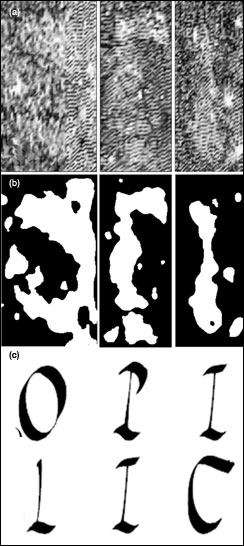
The area corresponding to the first name initial was affected by a crack and therefore impossible to analyze. The resulting images for the remaining letters (the surname) are shown in part (a) of the figure on the right, where some dark and brighter areas can be observed. To help the eye, we performed some additional basic image processing techniques (Gaussian blurring and binarization), which enabled us to obtain a clear image of the areas where the paint was (part b of the figure). This result, by itself, was not conclusive enough to determine the missing letters. As a consequence, we needed to delve deeper by making use of historical information. Solution to the puzzleAs we mentioned earlier, there were two possible occasions in which a consul could have been named Quintus Fabius. In the year 121 B.C.E., the consul Quintus Fabius Maximus Allobrogicus was ruling together with the consul Lucius Opimius. Later, in the year 116 B.C.E., Quintus Fabius Maximus Eburnus was the consul in conjuction with Caius Licinius Geta. Therefore, one of the possibilities for the lost writing corresponded to the surname “OPI” (for Opimus) and the other one to “LIC” (for Licinius). To make the final analysis, we proceeded to compare our results with the two possible consul names using the Roman calligraphy Capitalis Rustica; see part (c) of the figure on the right. This calligraphy was the informal cursive capital letterform used in that time for painted inscriptions. Examining the two options, it is clear that the first letter could be an “O” and the last can be an “I.” In addition, there is a certain resemblance between the top part of the letter “P” in Capitalis Rustica and the central panel in (b). We therefore could confidently conclude that the missing name was Lucius Opimius, and the wine contained in the amphora was from the 121 B.C.E. harvest. This result provides what in archaeology is named a “terminus post quem” for the foundation of Iesso—in other words, the earliest point in time when the city could have been founded. Now, archaeologists must deduce the wine’s age to provide a more precise foundation date of Iesso. The authors want to thank Professors Josep Guitart and Josep Ros from the ICAC-Institut Català d’Arqueologia Clàssica in Tarragona, the Potronat d’Arqueologia de Gissona for their contribution to the archaeological aspects of the work, and Emilià Pola from the Generalitat of Catalunya, who initially encouraged the collaboration between the two research institutions. David Artigas, Iain G. Cormack and Pablo Loza-Alvarez are with the ICFO-Institut de Ciències Fotòniques and the department of signal theory and communications, Universitat Politècnica de Catalunya, Mediterranean Technological Park, Castelldefels, Spain. References and Resources >> K.A. Robson Brown et al. “An Automated Laser Scan Survey of the Upper Palaeolithic Rock Shelter of Cap Blanc,” J. Archaeol. Sci. 28, 283 (2001).
|