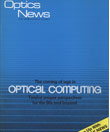
April, 1986 Issue
- Optical Computing at Carnegie-Mellon University
- Optical Computing Research at the University of Dayton
- Optical Computing Research at Heriot-Watt University
- The Role of Optics in Computation
- Issues in Optical Computing Research
- Approaching the All-Optical Computer
- The Optical Computing Process: Revolutionary or Evolutionary?
- Binary Optical Computing Architectures
- The Optical Margin
- Psychological Implications of Parallel Systems
- Optical Computing for the Strategic Defense Initiative
- Optical Computing: Some Hard Questions
- Browse all Issues
Feature Articles
Optical Computing at Carnegie-Mellon University
Optical computing is an area of research that has long intrigued many people. However, because of lack of knowledge and information on the topic and because of rapid advances in digital processing, industry has generally viewed this field as an area that has only produced cute ideas and much promise.
by David CasasentOptical Computing Research at the University of Dayton
Optical computing and processing research at the University of Dayton Research Institute (UDRI) was significantly expanded and intensified in the past year. The major focus of this research (which was supported by the Innovative Science and Technology Office of the Strategic Defense Initiative Organization and managed through an Office of Naval Research contract by Keith Bromley of the Naval Ocean Systems Center in San Diego), was a broad and fundamental investigation of thresholding operations in optical computing.
by Steven C. Gustafson and David L. FlanneryOptical Computing Research at Heriot-Watt University
Optical computing and processing research at the University of Dayton Research Institute (UDRI) was significantly expanded and intensified in the past year. The major focus of this research (which was supported by the Innovative Science and Technology Office of the Strategic Defense Initiative Organization and managed through an Office of Naval Research contract by Keith Bromley of the Naval Ocean Systems Center in San Diego), was a broad and fundamental investigation of thresholding operations in optical computing.
by W. Taylor and A. C. WalkerThe Role of Optics in Computation
The use of optics in signal processing and computing can be traced back to the design and fabrication of an optical processor at the Environmental Research Institute of Michigan (then Willow Run Laboratories) during 1960 for the reconstruction of synthetic aperture radar imagery. This is a very specialized and important application for which optical processors are still being used widely.
by Ravindra A. AthaleIssues in Optical Computing Research
In this article I would like to discuss several important issues in optical computing research. The views I express are personal. Feedback from you will be welcome, whether you agree with me or not.
by Sing H. LeeApproaching the All-Optical Computer
Twenty years from now, the central processor of the most powerful and fastest computers may be filled with optical pulses rather than electrical pulses. Already ultrashort pulses are generated and transmitted much more easily optically than electrically. Of course, plenty of electronics and electromechanical peripheral equipment will still interface to humans, machines, detectors, control equipment, and laser arrays. But the heart of the computer— where most of the decisions are made, where the computations are carried out, where the answers to complex problems are found—could very well be all-optical.
by Hyatt M. GibbsThe Optical Computing Process: Revolutionary or Evolutionary?
Perhaps the most dramatic development affecting the renewed interest in optical computers has come from nonlinear optics.
by Demetri PsaltisBinary Optical Computing Architectures
Binary parallel optical computing architectures differ greatly from traditional optical analog and numerical processors: they offer the possibility of high throughput and processing speed with arrays of fast optical switches that are being developed.
by B. Keith Jenkins and Alexander M. SawchukThe Optical Margin
Binary parallel optical computing architectures differ greatly from traditional optical analog and numerical processors: they offer the possibility of high throughput and processing speed with arrays of fast optical switches that are being developed.
by William T. RhodesPsychological Implications of Parallel Systems
Everyone agrees that parallel computing is inevitable. It seems to be the easiest way to gain additional speed with clever rearrangements of existing hardware. Optical systems are highly parallel in their architecture and well suited to parallel computation. As in all computers, the software and the hardware interact. What makes parallel computers different from the traditional kind is that this coupling is much closer: unless you know exactly what kind of software you want to run, there is not much point in building yet another parallel system, especially one that makes use of massive parallelism.
by James A. AndersonOptical Computing for the Strategic Defense Initiative
The concept of an optical computer, unlike its electronic counterpart, is nebulously defined, and the exact extent of "optical computing" is not yet delineated. As with most innovative technologies, there are widely diverging views on this subject.
by William MiceliOptical Computing: Some Hard Questions
If wisdom is cumulative, we must ask and distinguish between two hard questions. Is optical computing worth doing? How fast can it happen?
by H. John Caulfield
![A multiplexed image of a human tonsil acquired. [NIAID] using the iterative bleaching extends multiplexity (IBEX) method.](https://opnmedia.blob.core.windows.net/$web/opn/media/images/articles/2024/0424/departments/202404-cover-web.jpg?ext=.jpg)